Computational Thinking
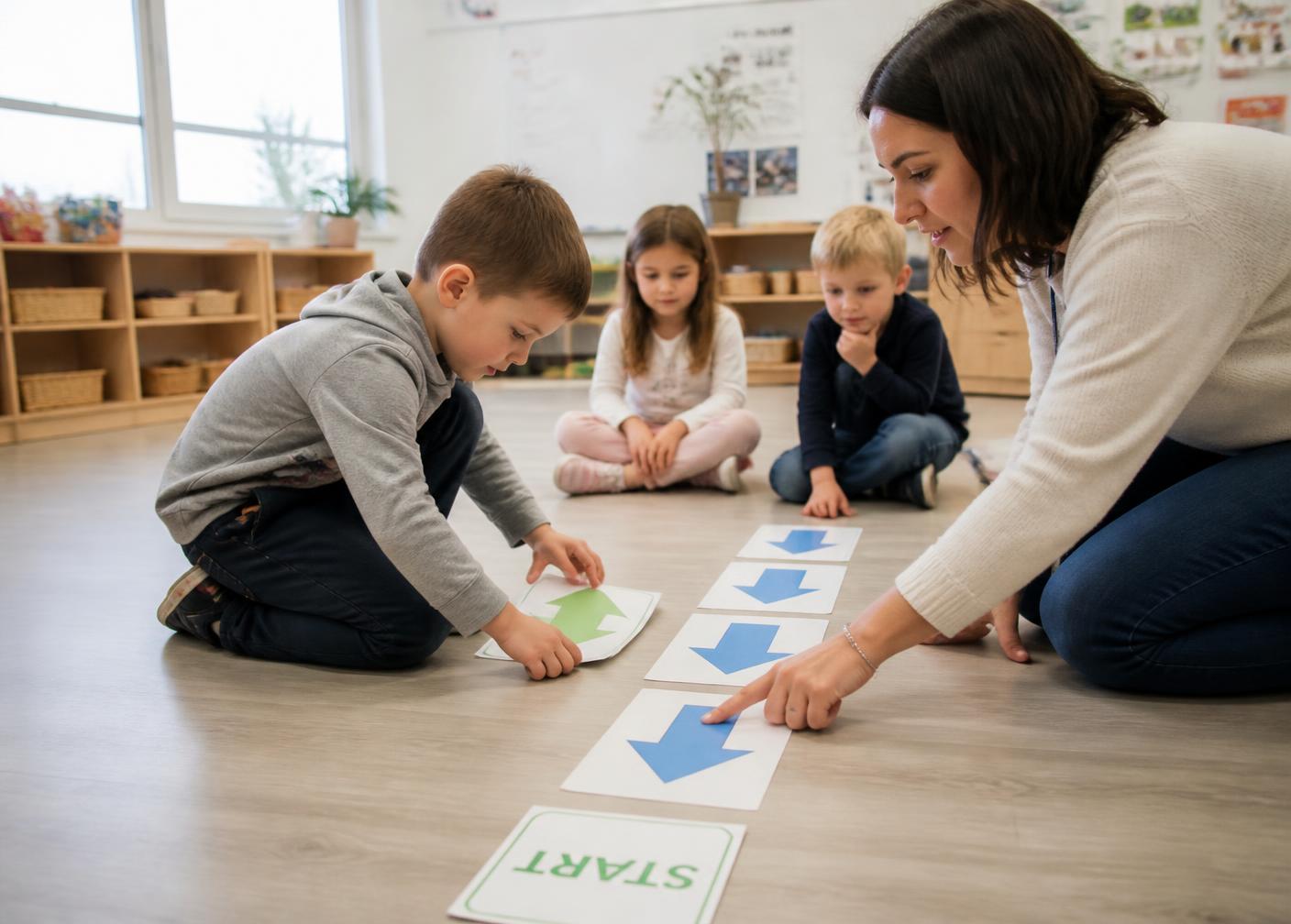
Introduces sequencing, decomposition, pattern recognition and debugging through physical activity.
Why STEMWORKS
STEMWORKS was designed backwards from the learning outcomes: what thinking do we want a five-year-old to practise, and what is the most engaging, screen-free way to practise it?
Screen-free philosophy
Computational thinking starts long before a child needs a tablet. Sequence, logic, cause and effect and debugging can all be learnt with the body, the floor and a stack of cards.
Because the instructions are physical, children can point at them, argue about them, swap them and immediately see the consequence of the change. Nothing is hidden behind an interface.
Why drones?
Not an 8-week enrichment course
STEMWORKS is designed as a year-long learning journey rather than a short workshop series. Concepts are introduced gradually, revisited in new contexts and then applied in increasingly challenging missions — which is how young children build durable understanding.
| Short enrichment course | STEMWORKS |
|---|---|
| One-off novelty sessions | A sequenced 12-month curriculum |
| A single skill demonstrated | Concepts revisited and deepened across four levels |
| Excitement that fades | Progression children and parents can see |
| Activity for its own sake | Missions tied to defined learning intentions |
The thinking cycle
Repetition of the cycle — not repetition of the activity — is what makes the learning stick.
Introduces sequencing, decomposition, pattern recognition and debugging through physical activity.
Provides opportunities to observe, predict and test ideas about air, movement and forces.
Encourages children to build, adjust and rebuild — and to notice why a change made a difference.
Supports understanding of direction, distance, position and orientation on grids and maps.
Introduces counting steps, comparing routes, measuring and simple estimation in context.
Provides structured opportunities to face a challenge, try an approach and adapt it.
Encourages children to explain their thinking, give clear instructions and listen carefully.
Supports turn-taking, shared responsibility and working towards a common mission goal.
Invites children to imagine new missions, new designs and new solutions to open challenges.
Encourages children to try, adjust and try again in a supportive, low-pressure setting.
Designed for how young children learn
Every activity has a learning intention behind the fun.
Children learn direction and sequence with their whole bodies.
Real materials children can hold, arrange and rearrange.
Missions give children a reason to care about solving the problem.
Predict, try, observe and discuss what actually happened.
Small groups plan together and share the outcome.
Concepts return across the year in new, richer contexts.
Difficulty is matched to K1 and K2 readiness.
Short guided conversations help children name what they learnt.
The programme has been designed with reference to relevant principles within Singapore's Nurturing Early Learners framework.
Questions
Clear answers for principals, centre directors and parents.
The future will be built by curious minds.
Bring a year of hands-on, screen-free STEM discovery to your preschool.